

Information about the EEIG
European Economic Interest Grouping - The Fundamentals
EEIG - The Fundamentals
The European Economic Interest Grouping (EEIG) is a legal organisational form created by the European Union to promote cross-border cooperation between enterprises.
Establishment
Legal capacity and registration in the European Economic Area
Auxiliary Company
Supporting the economic activity of its members
Members
Rights, obligations and voting procedures of members
Management
Representation and commitment towards third parties
Capital Endowment
Flexible financing methods without mandatory capital
Accounting
Bookkeeping and annual accounts under EU law
Establishment and Legal Capacity
The EEIG is fundamentally only available in the form of a new establishment. The founding treaty of an EEIG must contain the name, the registered office, the corporate purpose and the duration of the grouping.
This treaty must be registered in the register designated by the individual member states for this purpose. Registration confers full legal capacity on the EEIG throughout the Community.
The German EEIG Implementation Act refers to regulations on the general partnership. Thus, a German EEIG acquires legal capacity under Section 124 of the German Commercial Code (HGB).
In practice, this question is irrelevant because, by virtue of EU law, every EEIG can enter into contracts, sue or be sued, and has a manager.
The details of every formation or dissolution of an EEIG must be published in the Official Journal of the European Communities.
Use as an Auxiliary Company
In creating the legal basis for the EEIG, the EU intended to promote cross-border cooperation between enterprises.
It shall facilitate and develop the economic activity of its members. The EEIG itself is not oriented towards profit generation.
It may only perform auxiliary activities and is suitable as an auxiliary company to achieve common objectives.
Important restrictions:
- The EEIG may not be used for group management
- It may generally not hold shares in member companies
- The number of employees of an EEIG is limited to 500
The EEIG of the Senators is a special form defined by the statutes and registration.
Registered Office
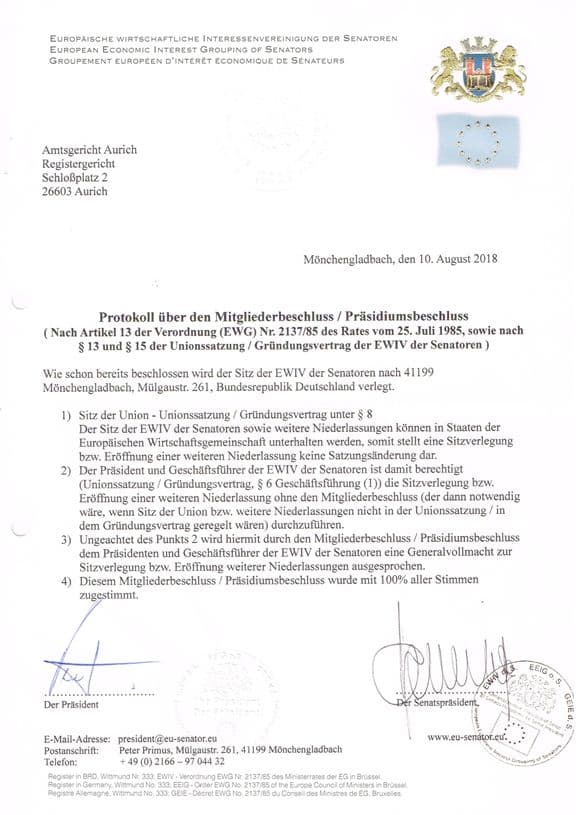
The registered office of an EEIG must be located in the European Economic Area (EEA); it may be transferred within the Community under certain conditions.
In our case, this decision is governed by the union statutes and the presidium resolution of 10 August 2018.
In a non-EU country, an EEIG may establish a branch office if this is possible under the applicable registration rules there.
Rights of Members; Associate Members
Each member of an EEIG normally has one vote. However, the founding treaty may grant certain members more than one vote.
Many EEIGs face the problem of wanting to include cooperations with members from third countries. For this purpose, there is the option of admitting them as associate members.
Associate members normally cannot vote but may cast indicative votes.
In our case, the question of member liability does not arise, as our Union may not incur any debts.
Management and Representation
The affairs of the EEIG are conducted by one or more natural persons appointed by the founding treaty or by resolution of the members.
Each manager represents and commits the EEIG vis-a-vis third parties, even if their actions do not fall within the corporate purpose.
Capital Endowment
An EEIG may not publicly access the capital market. An EEIG does not necessarily need to be endowed with capital. Membership contributions are customary.
Accounting
The managers are obliged to ensure proper accounting of the grouping and to prepare the annual accounts.
In our case this is governed by the union statutes. Accounting and annual accounts are regulated by Section 7 Annual Accounts.
Liability of Members
Members are liable without limitation and jointly and severally for liabilities, Art. 24 Regulation (EEC) No. 2137/85.
This takes the form of subsidiary liability, i.e. the EEIG itself is liable first, and only then the members.
Special provision of our Union: In our case, liability of members is excluded, as our Union may only use existing financial resources and may not incur any liabilities.